
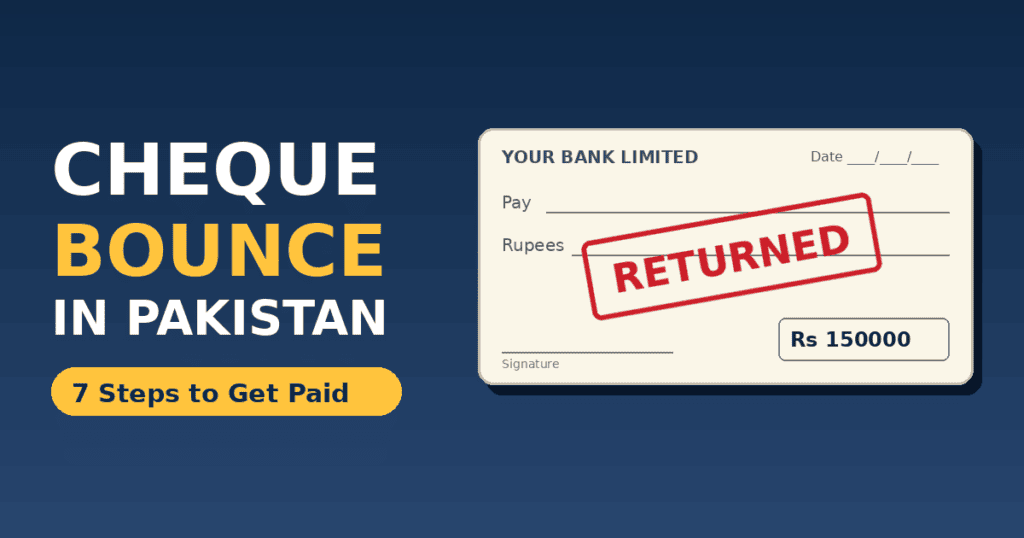
Cheque bounce in Pakistan: what it really means for your money
A cheque bounce in Pakistan happens when your bank refuses to pay a cheque, most often because the account does not have enough money. For the person waiting for that money, it feels like a door slammed shut. For the person who signed the cheque, it can turn into a police case.
This guide explains both sides in very easy words, with steps you can use this week. If you want the bigger picture first, read our overview of banking law in Pakistan.
A cheque can come back for many reasons:
- The account does not have enough balance
- The signature does not match the bank record
- The account is closed or frozen
- The cheque is older than six months, so the bank treats it as stale
- The amount in words and the amount in figures do not match
- The person who signed it told the bank to stop payment
Here is a small example. Rashid sells cloth worth Rs 150000 to a shopkeeper and receives a cheque. He deposits it on Monday. On Tuesday, the bank hands the cheque back with a slip that says insufficient funds. That slip is called the return memo, and it is the most important paper in the whole story. Every step below starts from it.
One honest note before we begin: this post gives general information in simple words. Your exact case may need a different path, so show your papers to an advocate before you act.
7 steps to follow after a cheque bounce in Pakistan
If you are the one who received the cheque, follow these seven steps in order. Each one protects your claim for the next.
Step 1: Take the return memo and keep the original cheque
Ask the bank for the return memo on the same day. Keep the original cheque safe and take clear photos of both papers. Also check the date on the cheque. Banks treat a cheque as stale after six months, so do not wait.
Step 2: Read the reason on the memo
The reason decides your next move.
- Insufficient funds: the money was not in the account. This is the case where a notice or legal action makes the most sense.
- Signature mismatch, stale cheque or wrong amount: this is often a simple mistake. Ask for a fresh cheque and note the date you asked.
- Payment stopped or account closed: ask for the reason in writing. This usually points to a dispute, and you will need stronger proof of the deal.
Step 3: Save proof of why the cheque was given
Courts look at the reason behind the cheque, not only at the cheque. Collect the invoice, receipts, agreement, WhatsApp chats, bank transfers, and the names of any witnesses. Put them in one folder, on your phone and on paper.
Step 4: Call first, then send a polite message
A phone call can solve the matter in one afternoon. After the call, send a short written message so there is proof. For example: “Dear Mr Tariq, the cheque dated 5 November for Rs 150000 was returned by the bank on 8 November. Please arrange payment by 13 November.” Stay calm and factual. Angry messages can be used against you later.
Step 5: Send a legal notice
If the payment does not come, send a legal notice by courier and by email or WhatsApp, and keep the receipts. Give a clear deadline, usually 7 to 15 days. Section 489F does not list a notice as a condition, but a notice shows that you acted fairly, and it pushes many people to settle. You can start from our legal notice draft format.
Step 6: Choose your path
You have three main roads, and you can talk to an advocate about which one fits.
- Settlement: agree on a payment plan in writing.
- Criminal complaint: an FIR under Section 489F of the Pakistan Penal Code, covered in the next section.
- Civil recovery: a summary suit on the cheque under Order 37 of the CPC. Read more in our CPC guide to summary suits. If the money is owed to or by a bank, the case may go to the Banking Court, explained in Banking Court procedure in Pakistan.
Keep one fact in mind. The Supreme Court has said that Section 489F is not meant to be a tool for recovering money, and that civil courts exist for that purpose. So a criminal case alone may not bring your money home.
Step 7: Settle in writing and close the matter properly
When the other side agrees to pay, write a compromise deed with the amount, the date, and the mode of payment. Prefer a pay order or a bank transfer over cash. Take back the bounced cheque and write “received” on your copy of the deed.
If a case is already running, tell your advocate right away, because courts have held that this offence can be compounded, which means settled between the parties, even during the trial.
What Section 489F says about cheque bounce in Pakistan
Section 489F of the Pakistan Penal Code makes it a crime to dishonestly issue a cheque to repay a loan or meet an obligation when that cheque is dishonoured on presentation. The punishment can go up to three years in prison, or a fine, or both, as the Law and Justice Commission of Pakistan report on Section 489F explains. The person who signed the cheque has one way out: to prove that he had made arrangements with his bank and that the bank was at fault in not paying.
For a case to stand, the court looks for these four things:
- The cheque was issued dishonestly
- It was given to repay a loan or to meet an obligation
- It was dishonoured when presented
- The bank was not the one at fault
The Sindh High Court repeats this test in a judgment that discusses the Supreme Court rulings on Section 489F. Here is what it means in real life:
- Not every bounced cheque is a crime. The Supreme Court said in Mian Allah Ditta (2013 SCMR 51) that a dishonoured cheque does not become an offence by itself.
- A cheque given only as security for a possible default in the future is not covered. The obligation has to exist on the day the cheque is issued (Mian Muhammad Akram, 2014 SCMR 1369).
- Bail is usually available. The maximum punishment does not fall under the prohibitory clause of Section 497 of the CrPC, and the Supreme Court has observed that bail should generally be granted (2022 SCMR 592). Read more in our CrPC guide to bail.
- Settlement is allowed. The Lahore High Court held that this offence can be compounded at any stage of the trial or appeal, as reported by Business Recorder.
- Recovery is not the goal. The Supreme Court said the section is not meant to collect money, because civil proceedings exist for that.
- Bank finance is different. If the cheque was given to repay a loan from a bank or financial institution, the special law (the Financial Institutions Recovery of Finances Ordinance 2001) and the Banking Court come into play. The same LJCP report explains that this route takes up to one year and is compoundable. We explain it in the Banking Court procedure in Pakistan.
Three real-life examples of cheque bounce in Pakistan
These stories are imaginary, but they match what happens in many offices and courts every week.
The cloth seller who stayed calm. Rashid’s Rs 150000 cheque came back for insufficient funds. He called the buyer, then sent a written message, then a legal notice with a 10-day deadline. On day eight, the buyer asked to pay in two parts. Rashid wrote a compromise deed, took the money by bank transfer, and returned the cheque. No police station, no court, and the full amount came home. The lesson: patience with paperwork often beats anger.
The security cheque trap. A landlord held a signed cheque as security from his tenant. When the tenant left, the landlord filled in Rs 300000 and deposited it. It bounced and he filed an FIR. The tenant’s advocate argued that the cheque was a security for a possible default in the future, not for an existing debt, which is exactly the kind of cheque the Supreme Court has said falls outside Section 489F. The lesson: if you take a security cheque, also keep a written agreement and proof of what is really owed.
The simple signature mistake. Ayesha paid her supplier with a cheque, but her signature did not match the bank record, so it came back. The supplier read the return memo, saw the reason, and asked for a fresh cheque instead of rushing to court. Payment arrived in two days. The lesson: read the reason on the memo before you decide anything.
How to stop cheque bounce in Pakistan before it starts
Most bounced cheques can be avoided with a few small habits. Here are simple checklists for both sides.
If you are the one writing the cheque:
- Check your balance on the day you hand over the cheque, and again two days later
- Write the date, the amount in words and the amount in figures with care, and make sure they match
- Sign the same way you signed at the bank
- Never give a cheque for a date when you are not sure money will be there. Say so openly and agree on a new date
- If a payment is going to fail, tell the other person before the cheque is deposited. An honest call early is far better than a notice later
- Never leave blank signed cheques with anyone you do not fully trust
If you are the one receiving the cheque:
- Write the name of the giver, the date and the reason for the payment in your own diary or phone notes
- Keep a copy of the invoice, agreement or chat that shows why the cheque was given
- Deposit the cheque soon, and never let it cross six months
- Ask the bank for the return memo the same day if it bounces
- Prefer a bank transfer for large payments, because it leaves a clear record
If your own account is frozen and that is why cheques are failing, see our guide to unfreezing a bank account in Pakistan so you can fix the root problem.
Frequently Ask Questions
1. Is every cheque bounce in Pakistan a crime?
No. Section 489F applies only when the cheque was issued dishonestly to repay a loan or meet an existing obligation, and the bank was not at fault. A bounce for a simple mistake, or a cheque given for something else, may not qualify.
2. What is the punishment under Section 489F?
Up to three years in prison, or a fine, or both.
3. Can a cheque bounce case be settled?
Yes. Courts have held that this offence can be compounded, which means settled between the parties, even during a trial or appeal.
4. Is a legal notice compulsory?
Section 489F does not list it as a condition, but a notice is wise. It proves you gave a fair chance, and it often leads to payment.
5. How long is a cheque valid in Pakistan?
Banks treat a cheque as stale after six months from its date, so deposit it early.
6. Does a security cheque count under Section 489F?
Usually not. The Supreme Court has said the obligation must exist at the time the cheque is issued, not a possible default in the future.
7. Can I get bail in a cheque bounce case?
Bail is generally granted because the maximum punishment does not fall within the prohibitory clause of Section 497 of the CrPC. Your advocate will apply it to the facts of your case.
8. Where do I go if the cheque was for a bank loan?
Cases about finance from a bank or financial institution are handled under a special law and the Banking Court. See the Banking Court procedure in Pakistan.
Question
Have you ever dealt with a bounced cheque, as the person who gave it or the person who received it? Tell us in the comments what happened and what helped you most.