
Why the First Ten Days of a Criminal Case Decide Everything
Almost every criminal matter that reaches an advocate’s office in Pakistan begins in the same place: a client sitting across the desk, either wanting to lodge an FIR or terrified that one has just been lodged against them. What happens in the days immediately after that meeting how the FIR is worded, whether the investigation is conducted properly, how witness statements are recorded, and whether a confession is ever made very often decides the case long before it reaches a Sessions Court or trial.
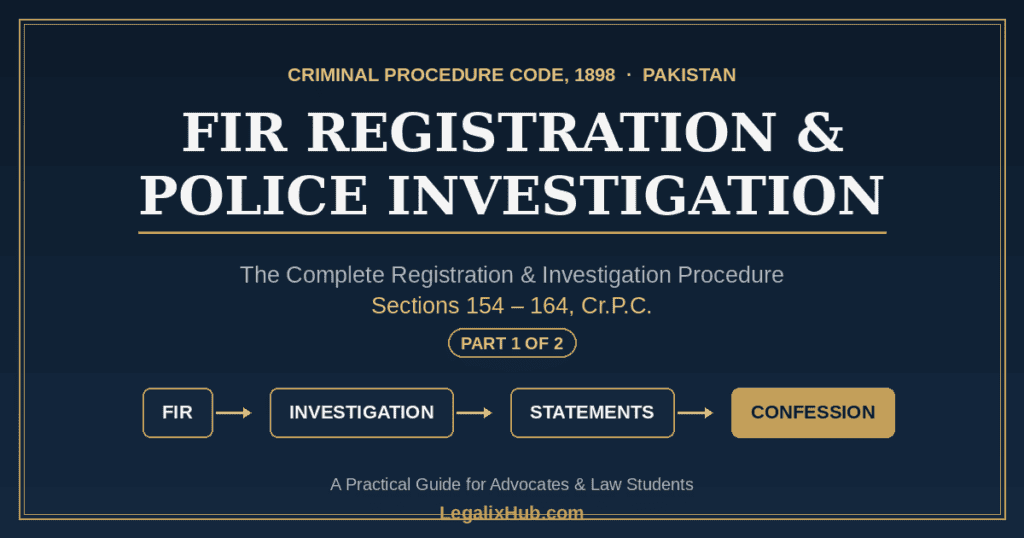
This is Part 1 of a two-part series on the FIR registration and police investigation procedure in Pakistan under the Code of Criminal Procedure, 1898. It covers Chapter XIV from the very first provision.
Section 154 (registration of the FIR), through to Section 164 (recording of confessions and statements), the entire information-and-investigation stage, before an accused is ever produced for remand. Part 2 covers what happens next: search, remand, and the final challan under Sections 165–173.
This guide is written for advocates and law students who need more than a bare-act summary; it explains what each provision says, how it plays out practically in the District Courts, and what the advocate is expected to do for the client at each individual stage.
What Does “FIR Registration and Investigation Procedure” Actually Cover?
Before the section-by-section detail, here is the shape of this stage of the FIR registration and police investigation procedure in Pakistan:
- Information reaches the police: As an FIR in cognizable cases, or a referral to the Magistrate in non-cognizable cases (Sections 154–155)
- Investigation is authorised and begins: With special rank restrictions for certain offences (Sections 156, 156-A, 156-B), and reporting obligations up the chain (Sections 157–159)
- Evidence is gathered from people: Witnesses are summoned, examined, and their statements recorded and protected from misuse (Sections 160–163)
- Statements and confessions are formalised before a Magistrate: With special safeguards in sexual-offence cases (Sections 164, 164-A, 164-B)
E
Everything in this stage happens before the police ever have to decide whether to seek remand or forward the accused that decision, and everything after it, is covered in Part 2.
Quick-Reference Table: Sections 154 to164 at a Glance
| Section | What It Covers | Advocate’s Role (One Line) |
|---|---|---|
| 154 | Registration of FIR in cognizable cases | Advise on FIR content; move 22-A/22-B or Article 199 if police refuse to register |
| 155 | Information in non-cognizable cases | Explain the distinction; move application before Magistrate or file under Section 200 |
| 156 / 156-A / 156-B | Police power to investigate; SP-rank rules for 295-C PPC and zina cases | Check the IO’s rank/jurisdiction for a possible legality challenge |
| 157 | Procedure once a cognizable offence is suspected | Track whether the IO visited the spot and secured evidence in time |
| 158 | Report routed through a superior police officer (if so directed) | Confirm the chain of transmission wasn’t skipped where it applies |
| 159 | Magistrate’s power to direct investigation or hold a preliminary inquiry | Move an application here if police decline to investigate under 157’s proviso |
| 160–161 | Summoning and examining witnesses | Counsel the client on what a 161 statement can and can’t be used for later |
| 161-A | Legal representation for a rape victim during her statement | Ensure this protection is actually extended in practice |
| 162 | Police statements not signed; limited evidentiary use | Use prior statements to confront witnesses; never let a client sign one |
| 163 | No inducement, threat, or promise in recording statements | Invoke this (with QSO Articles 38–39) to challenge coerced confessions |
| 164 / 164-A / 164-B | Magistrate-recorded confessions; medical exam and DNA testing in sexual offences | Advise carefully on confession consequences; ensure 164-A/164-B safeguards followed |
Section 154 CrPC | Information in Cognizable Cases (The FIR)
Section 154 is the starting point of the FIR registration and police investigation procedure in Pakistan. It requires that every piece of information relating to the commission of a cognizable offence, if given orally to the officer incharge of a police station, must be reduced into writing, read over to the informant, signed by him, and entered into a register maintained for that purpose.
Key points for practice:
- Registration of FIR under Section 154 is mandatory once a cognizable offence is disclosed; the police officer has no discretion to refuse it on the ground that the allegation “seems weak” or “needs verification” first.
- The informant does not have to be the victim; any person with knowledge of the offence can lodge it.
- Refusal to register an FIR is itself an offence under Section 166 PPC and can expose the officer to departmental and criminal liability.
Drafting note: A well-drafted FIR states the time and place of the occurrence clearly, names the accused (or gives a description if unknown), lists the injuries or loss caused, names the eyewitnesses, and avoids inflating the allegation beyond what actually happened. An exaggerated FIR is one of the most common reasons a case weakens at trial.
Advocate’s role at this stage: The advocate’s job often starts before the FIR even exists. Advising the client on what facts to state, in what sequence, and with what supporting documents (medical certificate, CNIC, ownership papers, CCTV, etc.) can shape the entire trajectory of the case.
If the police refuse to register the FIR, the advocate moves an application under Section 22-A/22-B CrPC before the Justice of Peace, or, where necessary, a constitutional petition under Article 199. This is also the stage to counsel the client honestly about whether the facts even disclose a cognizable offence, since an inflated or false FIR often backfires at trial.
Section 155 CrPC | Information in Non-Cognizable Cases
Where the offence disclosed is non-cognizable (for example, simple hurt or defamation), Section 155 requires the officer incharge to enter the substance of the information in the prescribed register and refer the informant to the Magistrate; the police cannot investigate such an offence without the Magistrate’s order.
Advocate’s role: This is where many complainants get confused, because they expect an FIR like in cognizable matters. The advocate explains the distinction, and where investigation is genuinely warranted, drafts and moves an application before the Magistrate seeking an order permitting police investigation, or advises filing a private complaint under Section 200 CrPC instead.
Sections 156, 156-A & 156-B CrPC | Police Power to Investigate
Section 156 gives the officer incharge of a police station the power to investigate any cognizable case without an order from a Magistrate, within the local limits of his police station’s jurisdiction. This is the provision that actually authorises the Investigating Officer (IO) to start collecting evidence once the FIR is registered under Section 154.
Two specialised sub-provisions carry rank-specific restrictions:
- Section 156-A restricts investigation of an offence under Section 295-C PPC (the blasphemy provision relating to the Holy Prophet ﷺ) to a police officer not below the rank of Superintendent of Police.
- Section 156-B protects women accused of zina; they cannot be arrested, and the offence can only be investigated by an officer of SP rank or above, without permission of the court, consistent with the Protection of Women (Criminal Laws Amendment) Act, 2006.
Advocate’s role: For the accused’s counsel, this is the point to verify whether the investigating officer is competent to investigate at all; a jurisdictional or rank defect at this stage (particularly in 295-C or zina-related matters) can be raised later to challenge the legality of the entire investigation.
Section 157 CrPC | Procedure Where Cognizable Offence Is Suspected
Once the officer incharge has reason to suspect the commission of a cognizable offence, Section 157 obliges him to send a report to the Magistrate and to proceed to the spot personally, or depute a subordinate, to investigate the facts, secure evidence, and, if necessary, arrest the offender. The same provision allows the officer to record in the case diary his reasons for not proceeding to investigate where he sees no sufficient ground, subject to the Magistrate’s supervisory power under Section 159.
Advocate’s role: The advocate for the complainant monitors whether the I.O has actually visited the spot, seized the relevant articles (weapon, clothes, documents), and recorded the site plan in time; delay here is a classic ground defence counsel later uses to attack the credibility of the prosecution case. Defence counsel, conversely, notes every delay and irregularity for cross-examination at trial.
Section 158 CrPC | Report How Submitted
Section 158 governs how the Section 157 report reaches the Magistrate. If the Provincial Government so directs, the report must be submitted through a superior police officer appointed for that purpose. That superior officer may give instructions to the officer incharge of the police station and must record those instructions on the report before forwarding it, without delay, to the Magistrate.
Advocate’s role: In sensitive or high-profile matters where a superior officer has been designated to supervise submission of reports, the advocate checks whether that chain was actually followed; a broken chain of transmission can sometimes be raised alongside other procedural irregularities.
Section 159 CrPC | Power to Hold Investigation or Preliminary Inquiry
Once the Magistrate receives the Section 157 report, Section 159 gives him the power to direct an investigation, or, if he thinks fit, to proceed himself (or depute a subordinate Magistrate) to hold a preliminary inquiry, or otherwise dispose of the case in the manner provided by the Code. This provision is primarily used where the police, relying on the proviso to Section 157(1), have decided not to investigate a case.
Advocate’s role: Where the police decline to investigate, most commonly in cases the officer considers too minor to pursue, this is the provision the complainant’s advocate invokes before the Magistrate to compel a proper investigation or preliminary inquiry.
Sections 160–161 CrPC | Summoning and Examining Witnesses
Section 160 empowers a police officer to require the attendance of any person within the local limits of his own or an adjoining station, who appears to be acquainted with the facts of the case. This power has built-in protections:
- Persons under 15 years of age, women, and persons with disabilities cannot be compelled to attend anywhere other than their own residence.
Section 161 then allows the police officer to orally examine any such person and record what is stated. The person examined is bound to answer truly all questions relating to the case, except those that would expose him to a criminal charge.
A protective provision, Section 161-A, additionally guarantees legal representation to a victim of rape and similar offences during recording of her statement.
Advocate’s role: This is one of the most under-utilised stages by junior advocates. The client should be counselled about what a Section 161 statement can and cannot be used for later (see Section 162 below), and, where the client is himself the victim of rape or a similar offence, the advocate ensures the protections under Section 161-A are actually extended during recording of the statement, including being present, or arranging for representation, during that recording.
Section 162 CrPC | Statements to Police Are Not to Be Signed
This is one of the most consequential and most misunderstood provisions in the FIR registration and police investigation procedure in Pakistan. Section 162 provides that no statement made to a police officer during investigation, if reduced into writing, shall be signed by the person making it, and subject to narrow exceptions, such a statement cannot be used for any purpose at any inquiry or trial, except to contradict the witness under the Qanun-e-Shahadat Order, 1984.
Advocate’s role: Defence counsel routinely use the police-recorded 161/162 statement to confront a prosecution witness with prior inconsistent statements during cross-examination. Prosecution-side counsel, correspondingly, must prepare witnesses for the possibility that minor variations between their 161 statement and court testimony will be exploited, and should never allow a client to sign a statement given to the police.
Section 163 CrPC | No Inducement to Be Offered
Section 163 prohibits any police officer or other person in authority from offering or making, or causing to be offered or made, any inducement, threat, or promise to a person for the purpose of obtaining a statement. This provision protects the voluntariness of statements and confessions gathered during investigation.
Advocate’s role: Where a client alleges that a statement or confession was extracted through coercion, threat, or inducement, this is the provision the advocate invokes alongside Articles 38 and 39 of the Qanun-e-Shahadat Order to challenge admissibility at trial.
Section 164, 164-A & 164-B CrPC | Recording of Statements, Confessions, and Special Protections
Section 164 allows a Magistrate to record any statement or confession made in the course of an investigation, at any time before commencement of the inquiry or trial. A confession recorded under this section must satisfy strict safeguards: the Magistrate must explain to the person that he is not bound to confess, that if he does, it may be used as evidence against him, and the Magistrate must be satisfied that the confession is being made voluntarily, typically after allowing a reflection period away from police custody.
Two connected provisions extend special protection in sexual-offence cases: Section 164-A requires medical examination of a victim of rape or similar offences, and Section 164-B provides for DNA testing where relevant to the investigation.
Advocate’s role: For the accused, this is a critical stage; advising a client on the consequences of making a Section 164 confession (and the near impossibility of retracting it later without a very strong explanation) is one of the most sensitive pieces of advice a criminal advocate gives.
For the complainant/victim side, the advocate ensures the client’s Section 164 statement is recorded promptly, before there is scope for pressure or compromise from the accused party, and that the medical/DNA safeguards under 164-A and 164-B are actually complied with in sexual-offence matters.
Practical Timeline: FIR to Confession, Step by Step
- Information received → FIR registered (Section 154) or referred to Magistrate (Section 155)
- Investigation authorised (Section 156, or 156-A/156-B for special offences)
- I.O proceeds to the spot, secures evidence, and sends report to the Magistrate (Section 157)
- Report routed through a superior officer where directed (Section 158)
- Magistrate directs investigation or preliminary inquiry if police decline to act (Section 159)
- Witnesses summoned and examined (Sections 160–161, with 161-A protections where applicable)
- Statements recorded but kept unsigned; not usable substantively at trial (Section 162)
- No inducement or coercion permitted in recording statements (Section 163)
- Confessions/statements recorded before a Magistrate where appropriate, with medical/DNA evidence in sexual offences (Sections 164, 164-A, 164-B)
From here, the case moves into custody, remand, and the final report to the Magistrate, covered in full in Part 2 of this series. If you’d rather see the entire journey from FIR to challan on one page first, our pillar guide, FIR to Challan Procedure in Pakistan, walks through the full roadmap at a glance.
A Note for Law Students and New Advocates
Every advocate learns Section 154 in the first year of practice, but very few are taught to think through Sections 157 to 164 as one connected sequence. Each provision exists to answer a specific question a client will actually ask: Can they refuse my FIR? Can they force my witness to come? Can they use what I told the police against me? Can I take back a confession? Knowing the answer instantly, section number included, is what separates a lawyer clients trust from one who has to “check and get back to you.”
Frequently Asked Questions
Q1. What is the difference between an FIR under Section 154 and a complaint under Section 200 CrPC? An FIR under Section 154 is lodged with the police for a cognizable offence and triggers police investigation. A complaint under Section 200 is filed directly before a Magistrate, typically used for non-cognizable offences or where the complainant prefers to bypass police investigation.
Q2. Can the police refuse to register an FIR under Section 154? No. If the information discloses a cognizable offence, registration is mandatory. Refusal can be challenged before the Justice of Peace under Section 22-A/22-B CrPC or through a constitutional petition.
Q3. Is a statement recorded under Section 161 admissible as evidence in court? No, except to contradict the witness during cross-examination under the Qanun-e-Shahadat Order, 1984. It cannot be used as substantive evidence to prove the truth of what was stated.
Q4. What happens if the police decide not to investigate a case at all? Under the proviso to Section 157(1), the police may record reasons for not investigating where they see no sufficient ground. The complainant can then move the Magistrate under Section 159, who may direct an investigation or hold a preliminary inquiry himself or through a subordinate Magistrate.
Q5. Can a confession made under Section 164 be withdrawn later? It can be retracted, but a retraction requires a strong, credible explanation such as proof of coercion or involuntariness, and courts scrutinise retracted confessions carefully rather than accepting them automatically.
Q6. What protection does a rape victim have while giving her statement to the police? Section 161-A guarantees her legal representation during the recording of her statement, and Sections 164-A and 164-B require prompt medical examination and, where relevant, DNA testing as part of the investigation.
What Would You Add?
Which of these provisions- Section 162’s bar on using police statements, or Section 164’s confession safeguards- do you find clients misunderstand the most when they first come to you? Share your experience in the comments.
Written by Ammar Khan, Advocate — Sindh Bar Council
Disclaimer
The content published on LegalixHub, including this article, is provided for general informational and educational purposes only and does not constitute legal advice. While every effort has been made to ensure the accuracy of the legal provisions, sections, and procedures discussed, laws are subject to amendment, judicial interpretation, and varying application across jurisdictions, and this content should not be relied upon as a substitute for professional legal counsel.
Reading this article does not create an advocate-client relationship between the reader and the author or LegalixHub. For advice on a specific legal matter, readers are strongly advised to consult a qualified advocate enrolled with the relevant Bar Council.