
Why the Remand-to-Challan Stage Is Where Most Bail Battles Are Won or Lost
By the time a case reaches remand, the FIR is already registered, and the investigation is already underway, but the hardest part, for both the client and the advocate, is often still ahead.
This is the stage where an accused person’s liberty is decided in fifteen-minute remand hearings, where the police either release him or send the file up, and where the entire investigation is finally reduced to one document the Magistrate will actually read: the challan.
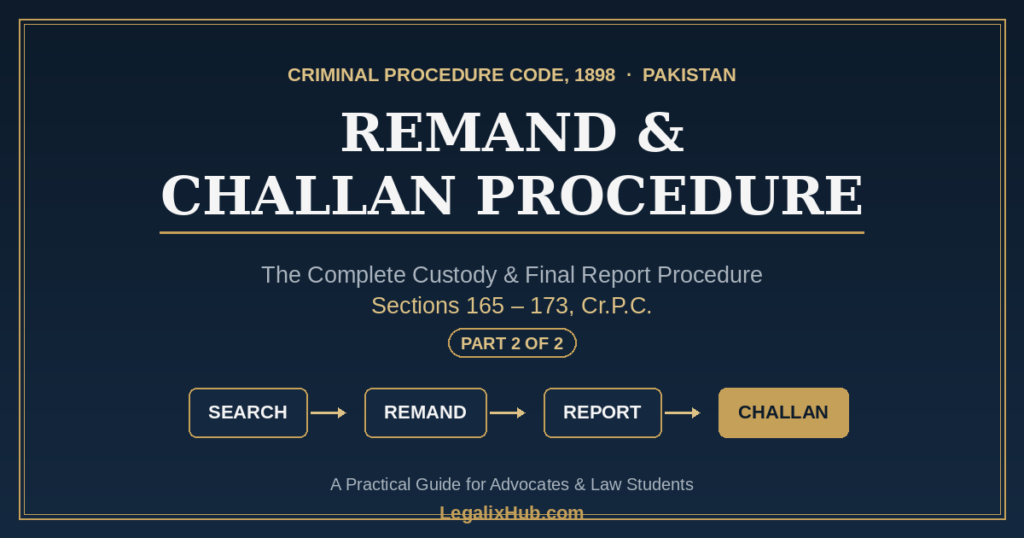
This is Part 2 of a two-part series on the FIR to challan procedure in Pakistan under the Code of Criminal Procedure, 1898. Part 1 covered registration of the FIR and the investigation stage: Sections 154 to 164. This part picks up from Section 165 (search by a police officer) and carries through to Section 173, the final report, popularly known as the challan or charge sheet.
Written for advocates and law students who need a working reference rather than a bare-act summary, this guide explains what each provision says, how it plays out in practice at the District Courts, and what the advocate is expected to do for the client at every stage from opposing an unnecessary remand to scrutinising the challan line by line.
What Does “Remand and Challan Procedure” Actually Cover?
Before the section-by-section detail, here is the shape of this stage of the remand and challan procedure in Pakistan:
- Search and evidence collection continue: With statutory conditions on how and when a police officer may search a place (Sections 165–166)
- Custody of the accused is decided: Through remand hearings where investigation cannot be completed quickly (Section 167)
- The file moves up the chain: A subordinate officer’s findings are reported and reviewed (Section 168)
- The police form their final opinion: Releasing the accused or forwarding him to court, while protecting witnesses from harassment (Sections 169–171)
- The investigation is documented and concluded: Through the case diary and the final report to the Magistrate (Sections 172–173)
Quick-Reference Table: Sections 165 to 173 at a Glance
| Section | What It Covers | Advocate’s Role (One Line) |
|---|---|---|
| 165 | Search by a police officer without a warrant, in defined circumstances | Check that reasons were recorded in writing before the search |
| 166 | Officer incharge requiring another station to issue a search warrant | Verify jurisdictional compliance where a search crosses station limits |
| 167 | Remand – police and judicial custody | Oppose unnecessary physical remand; build bail strategy |
| 168 | Report of investigation by a subordinate police officer | Check the report was properly routed through the officer incharge |
| 169 | Release of accused when evidence is deficient | Press for release here before the file is sent up |
| 170 | Case sent to Magistrate when evidence is sufficient | Prepare bail and challan-defence strategy once the client is forwarded |
| 171 | Complainants/witnesses not to be required to accompany the police, or subjected to restraint | Invoke this if a client-witness is being harassed into repeated attendance |
| 172 | Case diary maintained by the IO | Seek access at the right stage to spot contradictions and gaps |
| 173 | Challan/charge sheet – final (or interim) report to the Magistrate | Scrutinise annexures, timelines, and 1992-proviso compliance line by line |
Sections 165 & 166 CrPC | Search by a Police Officer
Section 165 allows an officer investigating to search a place himself, without first obtaining a search warrant, where he has reasonable grounds to believe that something necessary for the investigation may be found there and cannot otherwise be obtained without undue delay.
Before doing so, the officer must record in writing the grounds of his belief and, as far as possible, specify the thing for which the search is to be made, and, where practicable, search himself rather than deputing it to a subordinate.
Section 166 deals with the situation where the place to be searched is outside the local limits of the investigating officer’s own station: he can require the officer incharge of the station within whose limits the place is situated to cause the search to be made, or, if there is likely to be undue delay, can search himself after notifying the local station.
Advocate’s role: For the defence, checking whether a search under Section 165 was accompanied by a written record of the grounds, and whether that record was made before or conveniently after the search, is a standard and often fruitful line of scrutiny. Recoveries made without compliance with these safeguards are a frequent subject of cross-examination and legal argument at trial.
Section 167 CrPC | Remand: Police Custody and Judicial Custody
Section 167 governs what happens to the accused while the investigation is still ongoing. Where investigation cannot be completed within twenty-four hours of arrest (the constitutional limit under Article 10 of the Constitution), the officer incharge or the investigating officer (not below the rank of Sub-Inspector) must transmit case-diary entries and forward the accused to the nearest Magistrate, who may authorise detention in police custody or judicial custody for a term not exceeding fifteen days in the whole.
Several built-in safeguards apply:
- A Magistrate authorising police custody must record his reasons in writing and forward a copy of that order to the Sessions Judge.
- A Magistrate below a certain class cannot authorise police custody at all.
- Special protection for a female accused: except in cases of qatl or dacoity, supported by recorded reasons, she cannot be kept in police custody at all. Where interrogation is necessary, it must take place inside the prison itself, in the presence of a jail officer and a female police officer, and she must never be kept outside the prison between sunset and sunrise.
Advocate’s role: Remand hearings are where defence advocates do some of their most consequential work in the early life of a case:
- Opposing unnecessary physical (police) remand where judicial custody would suffice
- Insisting on medical examination of the accused before and after police custody to guard against custodial torture
- Tracking whether the investigation is genuinely progressing, or whether remand is being sought as a formality
- Building pre-arrest or post-arrest bail strategy around what is actually happening at each remand hearing
Section 168 CrPC | Report of Investigation by a Subordinate Police Officer
Where an investigation is conducted by a police officer subordinate to the officer incharge of the police station, Section 168 requires that officer to report the result of his investigation to the officer incharge, who then takes the matter forward as if he had conducted the investigation himself.
Advocate’s role: In cases with multiple investigating hands, common in complex or high-profile matters, the advocate checks whether every subordinate officer’s findings were actually routed back through the officer incharge, since a break in this chain can raise questions about who is truly responsible for the final report under Section 173.
Sections 169 & 170 CrPC | Release or Forwarding of the Accused
Once the investigation is complete, the officer incharge has to make a decision. Under Section 169, if it appears that there is no sufficient evidence or reasonable ground to justify forwarding the accused to a Magistrate, the officer must release him, subject to executing a bond to appear if and when required.
Under Section 170, if the evidence is found sufficient, the accused is forwarded to a Magistrate empowered to take cognizance of the offence upon a police report.
Advocate’s role: Defence counsel often make representations to the Investigating Officer or the SHO supported by documents, alibis, or forensic material arguing for release under Section 169 before the file is even sent up. Where the client has already been forwarded under Section 170, the advocate’s focus shifts to bail applications and preparing to scrutinise the eventual challan.
Section 171 CrPC | Protection for Complainants and Witnesses
Section 171 protects complainants and witnesses from being made to accompany a police officer unnecessarily, or being subjected to unnecessary restraint or inconvenience, and prescribes that any recusant complainant or witness who refuses to attend or execute a bond to attend before a Magistrate may only be forwarded in custody with the officer recording his reasons for doing so.
Advocate’s role: Where a complainant or a witness is a client and is being repeatedly summoned to accompany the police beyond what is reasonable, or is being pressured with the threat of being forwarded in custody, this is the provision to invoke both before the police and, if needed, before the supervising Magistrate.
Section 172 CrPC | The Case Diary
Section 172 requires every police officer investigating to maintain a day-to-day diary recording the time the investigation began and closed, the places visited, and a statement of the circumstances ascertained. This diary, commonly called the “Roznamcha” or case diary, is not itself evidence, but courts (and cross-examining counsel) may use it to test the investigation’s credibility, subject to statutory limits on how much of it can be shown to the defence.
Advocate’s role: Experienced defence counsel routinely seek access to the case diary at the appropriate stage to identify contradictions, gaps in the timeline, or evidence that was collected but never placed on the challan file.
Section 173 CrPC | The Challan (Report of Police Officer on Completion of Investigation)
Section 173 is the destination of the entire FIR-to-challan procedure in Pakistan. It requires that every investigation be completed without unnecessary delay, and that, as soon as it is completed, the officer incharge of the police station forward, through the Public Prosecutor, a report to the Magistrate empowered to take cognizance of the offence on a police report.
This report is what is popularly called the challan or charge sheet. The report must set out:
- The names of the parties
- The nature of the information
- The names of persons acquainted with the circumstances
- Whether the accused (if arrested) has been forwarded in custody or released on bond, with or without sureties
The officer must also communicate the action taken to the person who first gave the information.
Complete challan vs. interim challan: A complete challan is submitted only once the investigation is fully finished, with the full and final list of witnesses and all evidence the prosecution intends to rely on. Where certain witnesses remain untraced or certain formalities remain incomplete, courts have recognised the practice of submitting an interim challan, with the remaining material added later through a supplementary report.
A practical detail that is easy to miss: under a proviso added to Section 173 in 1992, if investigation is not completed within fourteen days of the FIR being recorded under Section 154, the officer incharge must, within three days of that period expiring, forward an interim report to the Magistrate through the Public Prosecutor, and the trial court is expected to commence trial based on that interim report unless it records reasons for not doing so.
Section 173 also requires that, along with the final report, the officer produce the witnesses in the case (other than public servants) so that the Magistrate can bind them to appear on the trial date. Where a superior police officer has been appointed under Section 158, and the Government has so directed, the report is routed through that officer, who may, pending the Magistrate’s orders, direct further investigation.
Pakistani courts have consistently held that, even though the Code does not contain an express “further investigation” sub-section, the submission of a report under Section 173 does not bar the police from carrying out further investigation and placing a supplementary report before the Magistrate if fresh evidence comes to light.
Challan scrutiny checklist for advocates:
- Are all seizure memos, medical reports, and forensic results actually annexed and internally consistent?
- Was the 14-day/3-day interim-report timeline under the 1992 proviso complied with, or is the challan itself late?
- Does the list of witnesses match those actually examined under Section 161?
- Has the Public Prosecutor genuinely reviewed the file, or merely countersigned it?
- Is there a basis to seek discharge, quashment under Section 561-A CrPC, or to build a bail/trial strategy around a weak or incomplete report?
Advocate’s role: Once the challan is filed, defence counsel’s task is to work through this checklist methodically. For the complainant, the advocate verifies that all relevant sections have been correctly applied and that no material witness or piece of evidence has been left out, and can press the investigating officer or move the court for further investigation where fresh evidence surfaces after the challan has already been submitted.
Practical Timeline: Remand to Challan, Step by Step
- Search conducted where necessary, with grounds recorded in writing (Sections 165–166)
- Accused produced and remand sought if investigation is ongoing (Section 167)
- Subordinate officer’s findings reported up the chain, where applicable (Section 168)
- Officer incharge decides: release the accused (Section 169) or forward him to the Magistrate (Section 170)
- Complainants and witnesses protected from unnecessary restraint throughout (Section 171)
- Case diary maintained across the entire investigation (Section 172)
- Interim report forwarded if 14 days pass without completion (Section 173 proviso)
- Challan/charge sheet submitted to the Magistrate through the Public Prosecutor (Section 173)
A Note for Law Students and New Advocates
Bar exams and moot courts test Section 167 as a remand provision and Section 173 as a challan provision, but the sections in between are just as consequential in real practice. A search conducted without recorded grounds under Section 165, a subordinate officer’s report never properly routed under Section 168, or a witness harassed in violation of Section 171 can each become a genuine line of defence at trial.
Knowing this stretch of the Code cold is what lets an advocate protect a client’s liberty long before the case ever reaches a Sessions Court. For the full journey from the very first FIR to this point, our pillar guide, FIR to Challan Procedure in Pakistan, covers the complete roadmap on one page.
Frequently Asked Questions
Q1. What is the maximum period of remand a Magistrate can grant under Section 167?
Detention authorised under Section 167 cannot exceed fifteen days in total. Beyond that, the case proceeds under the ordinary custody and bail provisions of the Code, and delay can itself become a ground for bail.
Q2. Can police search a house without a warrant in Pakistan?
Yes, under Section 165, a police officer may search a place without a warrant if he has reasonable grounds to believe something necessary for the investigation is there and cannot be obtained without undue delay, but he must first record his grounds in writing.
Q3. Can a woman accused be kept in police custody under Section 167?
Generally no. Except in cases of qatl or dacoity, supported by recorded reasons, a female accused cannot be kept in police custody, and any necessary interrogation must take place inside the prison, in the presence of a jail officer and a female police officer.
Q4. What is the difference between a complete challan and an interim challan?
A complete challan is filed once the investigation is fully finished, with the full list of witnesses and all evidence. An interim challan is filed where some material, such as missing witnesses or pending formalities, is still outstanding, with a supplementary report to follow later.
Q5. What happens if the police don’t submit the challan within a reasonable time?
Under the 1992 proviso to Section 173, if investigation is not completed within fourteen days of the FIR, the officer incharge must forward an interim report within three days of that period expiring, and the trial court is expected to commence trial on that basis unless it records reasons for not doing so.
Q6. Can a challan be revised or supplemented after it is submitted?
Yes. Courts in Pakistan have consistently held that submitting a report under Section 173 does not bar the police from carrying out further investigation, and a supplementary report can be placed before the Magistrate if fresh evidence is discovered.
What Would You Add?
In your experience, which stage causes more friction for clients: the remand hearings under Section 167, or waiting on a delayed challan under Section 173? Share your experience in the comments.
Written by Ammar Khan, Advocate — Sindh Bar Council
Disclaimer
The content published on LegalixHub, including this article, is provided for general informational and educational purposes only and does not constitute legal advice. While every effort has been made to ensure the accuracy of the legal provisions, sections, and procedures discussed, laws are subject to amendment, judicial interpretation, and varying application across jurisdictions, and this content should not be relied upon as a substitute for professional legal counsel.
Reading this article does not create an advocate-client relationship between the reader and the author or LegalixHub. For advice on a specific legal matter, readers are strongly advised to consult a qualified advocate enrolled with the relevant Bar Council.