
Why Every Criminal Case in Pakistan Follows the Same Legal Roadmap
Every criminal case in Pakistan, whether it is a simple scuffle case or a murder trial, travels through the same procedural road before it ever reaches a trial court. That road is laid down in Chapter XIV of the Code of Criminal Procedure, 1898, titled “Information to the Police and Their Powers to Investigate.” It begins the moment a complainant walks into a police station and ends when the Investigating Officer forwards his final report, commonly called the challan or charge sheet, to the Magistrate.
For a client, this stretch feels like a black box. For an advocate, it is the single most decisive phase of a criminal matter, because most cases are won or lost on how well the FIR-to-challan procedure in Pakistan was handled, long before arguments on charge or trial ever begin. A poorly drafted FIR, a delayed 154 registration, an unrecorded 161 statement, or a rushed 173 report can shape the outcome of a case far more than clever advocacy at trial.
This guide walks through the FIR to Challan procedure in Pakistan section by section, from Section 154 (registration of FIR) to Section 173 (submission of challan) in plain, practical language. At every stage, it explains what the law says, how it works on the ground in the District Courts, and what role the advocate is expected to play for the client at that exact point. It is written for advocates and law students who want a working reference, not just a bare-act summary.
What Does “FIR to Challan Procedure” Actually Mean?
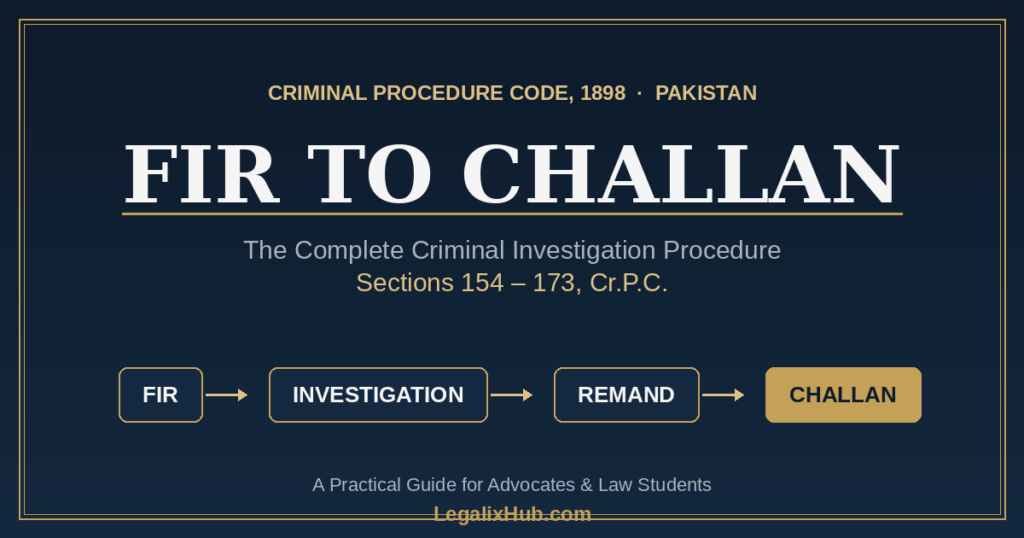
Before going section by section, it helps to see the full picture. The FIR to Challan procedure in Pakistan runs through three broad phases:
- Setting the law in motion: Registration of information (Sections 154–155)
- Investigation: The police gathering evidence, examining witnesses, arresting the accused, and seeking remand (Sections 156–172)
- Conclusion of investigation: The police officer forming an opinion and submitting the challan to the Magistrate (Section 173)
Everything that happens between the first phone call to the police station and the challan being fixed for judicial scrutiny falls somewhere inside these three phases. Understanding this structure makes each section easier to place and easier to explain to a worried client who only wants to know “what happens next.”
Quick-Reference Table: Sections 154 to173 at a Glance
For readers who just need the overview, here is every provision in the FIR to Challan procedure in Pakistan in one place. Scroll down for the full section-by-section breakdown with practical detail.
| Section | What It Covers | Advocate’s Role (One Line) |
|---|---|---|
| 154 | Registration of FIR in cognizable cases | Advise on FIR content; move 22-A/22-B or Article 199 if police refuse to register |
| 155 | Information in non-cognizable cases | Explain the distinction; move application before Magistrate or file under Section 200 |
| 156 / 156-A / 156-B | Police power to investigate; special SP-rank rules for 295-C PPC and zina cases | Check the I.O’s rank/jurisdiction for a possible legality challenge |
| 157 | Procedure once a cognizable offence is suspected | Track whether the I.O actually visited the spot and secured evidence in time |
| 160–161 | Summoning and examining witnesses | Counsel the client on what a 161 statement can and can’t be used for later |
| 161-A | Legal representation for a rape victim during her statement | Ensure this protection is actually extended in practice |
| 162 | Police statements not signed; limited evidentiary use | Use prior statements to confront witnesses; never let a client sign one |
| 163 | No inducement, threat, or promise in recording statements | Invoke this (with QSO Articles 38–39) to challenge coerced confessions |
| 164 / 164-A / 164-B | Magistrate-recorded confessions; medical exam and DNA testing in sexual offences | Advise carefully on confession consequences; ensure 164-A/164-B safeguards are followed |
| 167 | Remand – police and judicial custody | Oppose unnecessary physical remand; build bail strategy |
| 169 / 170 | Release of accused or forwarding to Magistrate | Push for release under 169 before the file is sent up; prep bail/challan defence if forwarded |
| 172 | Case diary maintained by the IO | Seek access at the right stage to spot contradictions and gaps |
| 173 | Challan/charge sheet – final (or interim) report to the Magistrate | Scrutinise annexures, timelines, and 1992-proviso compliance line by line |
Section 154 CrPC | Information in Cognizable Cases (The FIR)
Section 154 is the starting point of the roadmap. It makes registration of an FIR mandatory once a cognizable offence is disclosed; the police have no discretion to refuse it on the ground that the allegation “seems weak.” Refusal can be challenged before the Justice of Peace under Section 22-A/22-B CrPC, or through a constitutional petition under Article 199.
Advocate’s role: Advise the client on FIR content and supporting documents before it is even lodged, and push back immediately if the police refuse to register it.
Section 155 CrPC | Information in Non-Cognizable Cases
Where the offence disclosed is non-cognizable (for example, simple hurt or defamation), Section 155 requires the officer incharge to refer the informant to the Magistrate; the police cannot investigate such an offence without the Magistrate’s order.
Advocate’s role: Explain this distinction to the client, and either move an application before the Magistrate or advise a private complaint under Section 200 CrPC instead.
Section 156 & 156-A CrPC | Police Power to Investigate
Section 156 authorises the officer incharge to investigate a cognizable case without a Magistrate’s order. Two rank-specific restrictions apply: Section 156-A limits investigation of Section 295-C PPC (blasphemy) to an SP-rank officer, and Section 156-B similarly restricts zina investigations to SP rank, without permission of the court, and bars arrest of the woman accused.
Advocate’s role: Check the I.O’s rank and jurisdiction; a defect here can later be used to challenge the legality of the entire investigation.
Section 157 CrPC | Procedure Where Cognizable Offence Is Suspected
Once a cognizable offence is suspected, Section 157 requires the officer incharge to send a report to the Magistrate and proceed to the spot to investigate, secure evidence, and arrest the offender if necessary.
Advocate’s role: Track whether the I.O actually visited the spot and secured evidence in time; delay here is a classic ground defence counsel exploit at trial.
Sections 160–161 CrPC | Summoning and Examining Witnesses
Section 160 lets police summon any person acquainted with the facts, with protections for minors, women, and persons with disabilities, and Section 161 lets them examine and record what is stated. Section 161-A guarantees legal representation to a rape victim during her statement.
Advocate’s role: Counsel the client on what a 161 statement can and cannot be used for later, and ensure 161-A protections are actually extended where relevant.
Section 162 CrPC | Statements to Police Are Not to Be Signed
Section 162 is one of the most consequential provisions in the whole chapter: a statement made to police cannot be signed by the person who gave it, and, with narrow exceptions, cannot be used as evidence at trial, except to contradict the witness under the Qanun-e-Shahadat Order, 1984.
Advocate’s role: Use prior Section 161 statements to confront witnesses during cross-examination, and never let a client sign a statement given to police.
Section 163 CrPC | No Inducement to Be Offered
Section 163 bars any inducement, threat, or promise being used to obtain a statement, protecting its voluntariness.
Advocate’s role: Invoke this alongside Articles 38–39 of the Qanun-e-Shahadat Order to challenge a coerced confession’s admissibility.
Section 164 CrPC | Recording of Statements and Confessions
Section 164 lets a Magistrate record a statement or confession before trial, subject to strict safeguards on voluntariness. Section 164-A requires medical examination of a rape victim, and Section 164-B provides for DNA testing.
Advocate’s role: Advise carefully on the near-irreversible consequences of a Section 164 confession, and ensure the 164-A/164-B safeguards are actually followed in sexual-offence matters.
Everything covered so far, Sections 154 to 164, is broken down in full depth in our companion guide, FIR Registration and Police Investigation Procedure in Pakistan. What follows below is where custody, remand, and the final challan take over.
Section 167 CrPC | Remand: Police Custody and Judicial Custody
Although it falls slightly outside the strict 154 to173 sequence in the CrPC’s own numbering, no discussion of the FIR to Challan procedure in Pakistan is complete without Section 167. It governs custody while investigation continues: where investigation cannot finish within twenty-four hours (the Article 10 constitutional limit), the accused is produced before a Magistrate, who may authorise police or judicial custody for up to fifteen days in the whole, with special protections for a female accused, who generally cannot be kept in police custody at all.
Advocate’s role: Oppose unnecessary physical remand, insist on medical examination during custody, and build bail strategy around what is actually happening at each hearing.
Sections 169–170 CrPC | Release or Forwarding of the Accused
Under Section 169, the officer must release the accused if evidence is deficient, on a bond to appear if required. Under Section 170, if evidence is sufficient, the accused is forwarded to the Magistrate.
Advocate’s role: Push for release under Section 169 before the file is sent up; once forwarded under Section 170, shift focus to bail and challan-defence strategy.
Section 172 CrPC | The Case Diary
Section 172 requires the I.O to maintain a day-to-day case diary. It is not evidence itself, but courts and cross-examining counsel may use it to test the investigation’s credibility, subject to statutory limits on how much can be shown to the defence.
Advocate’s role: Seek access at the right stage to spot contradictions and gaps.
Section 173 CrPC | The Challan (Report of Police Officer on Completion of Investigation)
Section 173 is the destination of the entire FIR-to-challan procedure in Pakistan. It requires the officer incharge to forward, through the Public Prosecutor, a final report to the Magistrate, stating the parties, the nature of the offence, the persons acquainted with the circumstances, and whether the accused is in custody or on bond.
Under a 1992 proviso, an interim report must be forwarded if investigation is not completed within 14 days of the FIR, and Pakistani courts have consistently held that further investigation and a supplementary report remain possible even after a challan is submitted.
Advocate’s role: Scrutinise the challan line by line, annexures, timeline compliance, the witness list, and whether grounds exist to seek discharge, quashment under Section 561-A CrPC, or a strong bail/trial strategy.
For a deeper, provision-by-provision look at search, remand, and everything leading up to this final report, see our companion guide, Remand and Challan Procedure in Pakistan.
Practical Timeline: The FIR to Challan Procedure in Pakistan, Step by Step
- Information received → FIR registered (Section 154) or referred to Magistrate (Section 155)
- Investigation authorised (Section 156, or 156-A/156-B for special offences)
- IO proceeds to the spot, secures evidence (Section 157)
- Witnesses summoned and examined (Sections 160–161, with 161-A protections where applicable)
- Statements recorded but kept unsigned; not usable substantively at trial (Section 162)
- No inducement or coercion permitted in recording statements (Section 163)
- Confessions/statements recorded before a Magistrate where appropriate, with medical/DNA evidence in sexual offences (Sections 164, 164-A, 164-B)
- Accused produced and remand sought if investigation is ongoing (Section 167)
- Case diary maintained throughout (Section 172)
- Accused released (Section 169) or forwarded to court (Section 170)
- Challan/charge sheet submitted to the Magistrate through the Public Prosecutor (Section 173)
A Note for Law Students and New Advocates
The FIR to Challan procedure in Pakistan is tested constantly in moot courts, bar exams, and, more importantly, in a client’s living room the day after an FIR is registered against a family member. Memorising section numbers is only half the job. The advocate who understands why Section 162 exists, or why remand hearings under Section 167 matter more than most junior lawyers realise, is the one who actually protects a client’s liberty at the stage when it matters most, long before the case ever reaches a Sessions Court.
Frequently Asked Questions
Q1. How long does the FIR to Challan process typically take in Pakistan?
There is no fixed timeline, but the Code pushes for speed: the 1992 proviso to Section 173 requires an interim report if the investigation is not finished within 14 days of the FIR, and remand under Section 167 is capped at fifteen days in total, though complex cases routinely take longer in practice.
Q2. Does every criminal case go through all the stages under Sections 154 to 173?
Not every case reaches remand or a lengthy investigation; a straightforward matter can move from FIR to challan quickly, with the accused released under Section 169. But every cognizable case does pass through the registration and investigation framework in some form.
Q3. What is the legal difference between a challan and an FIR?
The FIR under Section 154 is the starting document that sets the investigation in motion. The challan under Section 173 is the concluding document, the police officer’s final report to the Magistrate after investigation, stating whether an offence is made out and against whom.
Q4. What happens if the investigation is not completed within the remand period under Section 167?
The Investigating Officer must seek further remand from the Magistrate by justifying the delay. If the Magistrate is not satisfied, or if the outer statutory limit is reached, the accused may become entitled to bail on the ground of default under the relevant bail provisions.
Q5. Can an advocate get involved before the FIR is even registered?
Yes, and it is often the most valuable moment to do so. Advising on what facts to state, what documents to gather, and how to word the complaint can shape the entire trajectory of the case before a single section of the Code is even formally invoked.
Q6. Where can I read the detailed procedure for each stage?
This guide is the full roadmap. For a deeper, provision-by-provision breakdown, the registration-and-investigation stage (Sections 154–164) and the remand-and-challan stage (Sections 165–173) are each covered separately, linked above.
What Would You Add?
Which stage of the FIR-to-challan procedure in Pakistan do you find advocates and clients misunderstand the most: the remand stage under Section 167, or the evidentiary limits of Section 162 statements? Share your experience in the comments.
Written by Ammar Khan, Advocate – Sindh Bar Council
Disclaimer
The content published on LegalixHub, including this article, is provided for general informational and educational purposes only and does not constitute legal advice. While every effort has been made to ensure the accuracy of the legal provisions, sections, and procedures discussed, laws are subject to amendment, judicial interpretation, and varying application across jurisdictions, and this content should not be relied upon as a substitute for professional legal counsel.
Reading this article does not create an advocate-client relationship between the reader and the author or LegalixHub. For advice on a specific legal matter, readers are strongly advised to consult a qualified advocate enrolled with the relevant Bar Council.