

Res Judicata vs Res Sub Judice in Pakistan: Section 11 vs Section 10 CPC
Two brothers. One plot in Karachi. Two different courts, and both brothers swear the plot is theirs. The first case is still being heard in one court. The second has just landed in another. Which case survives?
Now change the story. What if the first case was already decided five years ago and the loser is back with a fresh suit? Can the court even listen to him?
The answer to both questions lies in the difference between res judicata vs res sub judice, and it is asked in almost every CPC paper in Pakistan. Law students mix the two up all the time, and so do many young advocates in court.
Quick answer: Res sub judice (Section 10 CPC) means the matter is still pending in a court, so a second case on the same matter must wait. Res judicata (Section 11 CPC) means the matter has already been finally decided, so it cannot be fought again.
In this post, we explain both in plain language, compare them side by side, and walk through practical examples that you can actually imagine happening in a District Court in Karachi.
What Is Res Judicata vs Res Sub Judice? The Cricket Match Way to Remember It
The Latin words are simple. “Res” means a thing or a matter. “Judicata” means decided. “Sub judice” means under the consideration of a judge.
Now think about a cricket match at the National Stadium in Karachi.
While the match is still being played, nobody can start a second match between the same two teams for the same trophy at the same time. The first match has to finish first. This is res sub judice: the matter is still running.
Once the umpires announce the result and the trophy is handed over, nobody can come back next week and say “let us play again for the same trophy”. The result is final. This is res judicata: the matter is already judged.
One line to remember for the exam and for court: sub judice means still running, judicata means judged and done.
Remember it like this: Sub judice means still running, so the second case waits. Judicata means judged and done, so the second case is barred. First case still on? Think stay. First case over? Think barred.
Res Judicata vs Res Sub Judice: Section 10 CPC (Res Sub Judice) Explained
Section 10 CPC is titled “Stay of suit”. In simple words, it says that a court cannot proceed with the trial of a later suit if the same matter is already in issue in an earlier suit between the same parties, and that earlier suit is still pending in a court having jurisdiction to grant the relief claimed.
The five conditions of Section 10
- Two suits: one filed earlier, one filed later.
- The same matter is directly and substantially in issue in both (a side point is not enough).
- Same parties, or those claiming under them, under the same title.
- The earlier suit is still pending.
- The earlier court can grant the relief claimed in the later suit.
What exactly happens when Section 10 applies
- The later suit is stayed, not dismissed. It is paused until the first suit is decided.
- Section 10 stops the trial of the later suit. It does not stop the filing of the later suit.
- The language of the section is “no court shall proceed”, so once all five conditions are met the court has no discretion to continue the trial.
- A suit pending in a foreign court does not trigger Section 10. A Pakistani court can still try the later suit.
A simple test to apply
Ask yourself one question: if the first suit were decided today, would that decision operate as res judicata in the second suit? If yes, Section 10 is the right tool to stop the second suit from running in parallel.
What if the conditions are not fully met?
Courts also have inherent powers under Section 151 CPC. Where the conditions of Section 10 are not strictly satisfied, a court may still stay a suit to meet the ends of justice and to avoid conflicting judgments.
Why the law has this rule
If two courts decide the same dispute at the same time, they may give two different answers. Then neither party knows which judgment to obey. Section 10 keeps one dispute in one court at a time.
Exam trap: Section 10 stays the second suit, it does not dismiss it. And it stops the trial, not the filing. Examiners love this one.
Res Judicata vs Res Sub Judice: Section 11 CPC (Res Judicata) Explained
Section 11 CPC says that no court shall try a suit or an issue which has been directly and substantially in issue in a former suit between the same parties, litigating under the same title, in a court competent to try the later suit, and which has been heard and finally decided by that court.
The four conditions of Section 11
- The same matter was directly and substantially in issue in the former suit.
- Same parties, or those claiming under them, under the same title.
- The former court was competent to try the later suit (a right of appeal is irrelevant to competence).
- The matter was heard and finally decided.
Suit or issue
Notice the words “suit or issue”. Res judicata does not apply only when the whole suit is the same. Even a single issue that was finally decided in an earlier case can bind the parties in a later case.
Constructive res judicata (the one students forget)
Explanation IV to Section 11 says that any matter which might and ought to have been made a ground of attack or defence in the former suit is treated as if it was actually decided. This is called constructive res judicata. It stops parties from fighting the same dispute in installments by saving one argument for the next case.
Why the law has this rule
Two old principles sit behind Section 11. First, it is in the public interest that litigation must end (interest reipublicae ut sit finis litium). Second, nobody should be troubled twice for the same cause (nemo debet bis vexari pro una et eadem causa). A decree is of no value if the loser can simply file a fresh suit.
Exam trap: Do not skip constructive res judicata. If a point could and should have been raised earlier, it is treated as decided. Many students lose marks by forgetting Explanation IV.
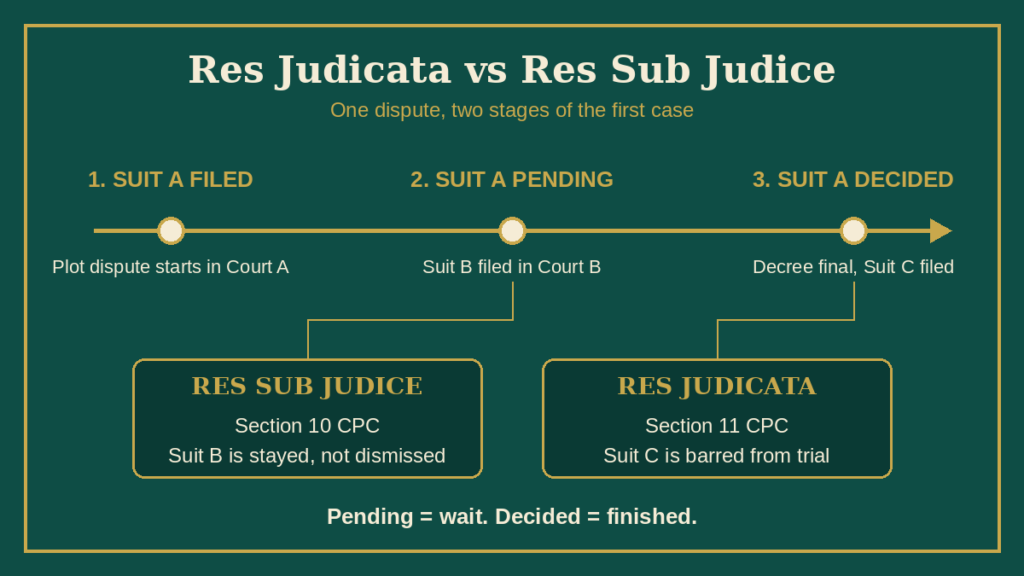
Res Judicata vs Res Sub Judice: Difference Table
| Point | Res Sub Judice | Res Judicata |
|---|---|---|
| Section of CPC | Section 10 | Section 11 |
| Meaning | Matter is pending | Matter is decided |
| Position of the first case | Still under trial | Finally decided |
| Effect | Trial of the later suit is stayed | Later suit or issue cannot be tried |
| Does it stop filing? | No, only trial | The court is barred from trying the same matter again |
| Main purpose | Stop two parallel cases | Stop a repeat case |
| Simple test | Would the first decision be res judicata in the second suit? | Was the same matter already finally decided by a competent court? |
| Foreign courts | Pending foreign suit does not attract it | Foreign judgments are dealt with under Section 13 CPC |
| Example | Two suits on one plot running together | Fresh suit on a plot after the first suit was lost |
Res Judicata vs Res Sub Judice Examples: Practical Courtroom Scenarios
Example 1: Res sub judice (Section 10)
Rashid files a suit for declaration of ownership and permanent injunction against Salman for a plot in Gulshan-e-Iqbal in the court of a Senior Civil Judge in Karachi. The suit is pending.
A few months later, Salman files his own suit in another court in Karachi, claiming that he is the owner of the same plot, against the same Rashid.
The parties are the same, the ownership question is the same, the first suit is pending, and its court can give the relief claimed. Rashid files an application under Section 10 in the second suit.
Result: the trial of Salman’s suit is stayed until Rashid’s suit is decided. It is not dismissed.
Example 2: Res judicata (Section 11)
Take the same dispute. After a full trial, Rashid’s suit is dismissed on merits because he could not prove ownership. No appeal succeeds and the decree becomes final.
Rashid now files a fresh suit about the same plot against the same Salman, but changes the title of the suit to “cancellation of sale deed”. The real question is still the same: who owns the plot.
Result: the new suit is barred by Section 11. Changing the heading of the suit does not change the matter in issue.
Example 3: Constructive res judicata
Fahad sues Hina for recovery of Rs. 5,000,000 on a written agreement. Hina defends only by saying she already paid part of the amount. The court decrees the suit.
Later, Hina files a new suit claiming that the agreement itself was forged. She could and should have taken this ground as her defence in the first suit.
Result: under Explanation IV, the forgery ground is treated as already decided against her. She cannot raise it now.
Example 4: What is NOT res judicata
A plaint is rejected under Order VII Rule 11 CPC because the plaintiff did not correct the valuation or pay the court fee. Nothing was decided on the merits. Under Order VII Rule 13 CPC, the plaintiff is not prevented from presenting a fresh plaint on the same cause of action. This is why a rejection of plaint is different from a decree after trial. You can read more in our Order VII Rule 11 CPC in Pakistan guide.
Test Yourself: Res Judicata vs Res Sub Judice Quiz
Cover the answers and decide before you read them.
Scenario 1. Ali sues Bilal over a shop in Saddar. While that trial is running, Bilal files his own suit over the same shop in another Karachi court. What applies?
Answer: Res sub judice. Section 10 CPC. The later suit is stayed until Ali’s suit is decided.
Scenario 2. Sana’s suit to recover the same debt was dismissed after a full trial three years ago and the decree is final. She files again with a different heading. What applies?
Answer: Res judicata. Section 11 CPC. The matter was heard and finally decided, so the new suit is barred.
Scenario 3. A plaint is rejected under Order VII Rule 11 because the court fee was not paid. The plaintiff files a fresh plaint. What applies?
Answer: Neither. Nothing was decided on merits, and Order VII Rule 13 allows a fresh plaint.
How an Advocate Raises Res Judicata vs Res Sub Judice, Stage by Stage
If the matter is pending elsewhere (Section 10)
- Collect proof first. Get the case number, the court and certified copies of the plaint and the latest order sheet of the first suit, showing that it is still pending.
- File an application under Section 10 CPC, with Section 151 CPC as an alternative ground, in the later suit. File it as early as possible, ideally along with or soon after the written statement and certainly before issues are framed.
- Show the five conditions. Keep the application short and set out the same parties, same matter, same title, pendency and jurisdiction in separate paragraphs.
- If a stay is refused, the usual route is a revision under Section 115 CPC. Check the limitation carefully. High Courts do not like direct constitutional petitions where a remedy already exists in the CPC.
- Urgent situation: if the other side is rushing for an ad interim injunction in the later suit, raise Section 10 at the very first hearing. Do not wait for the stage of issues.
If the matter is already decided (Section 11)
- Plead it in the written statement as a specific preliminary objection, with the number of the earlier suit, the court and the date of the decree.
- Get certified copies of the earlier plaint, written statement, issues, judgment and decree, plus appeal or revision orders if any.
- Ask the court to frame an issue on res judicata and to decide it first where it can be decided from the record alone. Our guide to civil procedure in Pakistan from institution to judgment explains where preliminary issues fit in the life of a suit.
- Consider Order VII Rule 11(d) where the bar is clear from the plaint itself. Courts are careful here, because res judicata is often a mixed question of law and fact.
- Read the earlier pleadings line by line. A constructive res judicata argument works only if you can show that the point could and should have been taken before.
If you are the plaintiff with a lost case
Before filing a fresh suit, check three things. Was the earlier case decided on merits? Is the matter in issue really different? Has a new cause of action arisen after the first decree? A genuinely new cause of action is not barred.
Malafide and Dishonesty Markers in Res Judicata vs Res Sub Judice Cases
Courts look at the conduct of the party, not just the technical conditions. These are the signs that usually show bad faith:
- The second suit is filed in a different court soon after losing an interim application, hoping for a friendlier judge (forum shopping).
- The plaint hides the existence of the first suit or the earlier decree.
- A party is added or dropped, or the prayer is reworded, only to escape the bar.
- The property description is changed (new survey or khasra number, new boundaries) to make an old dispute look new.
- An application under Section 10 is filed late, again and again, only to delay the trial. This is misuse of the section.
In such cases, a court can stay or dismiss the later proceedings and may award compensatory costs under Section 35-A CPC for false or vexatious claims or defences.
Common Mistakes in Res Judicata vs Res Sub Judice Answers
- Writing that Section 10 “dismisses” the second suit. It only stays it.
- Saying Section 10 bars filing. It bars trial.
- Forgetting constructive res judicata under Explanation IV.
- Treating every rejection of plaint as res judicata. Rejection for a defect is not a decision on merits.
- Mixing up Section 11 with Order II Rule 2, which is about splitting claims within one cause of action, and with Section 12 CPC, which bars a further suit on a cause of action in respect of which a plaintiff is barred under the rules.
Exam tip: In a problem question, always do four steps. First, identify the stage of the first case (pending or decided). Second, match the parties and the matter in issue. Third, apply the right section. Fourth, state the effect: stay under Section 10, bar under Section 11.
Frequently Asked Questions on Res Judicata vs Res Sub Judice
1. Can a second suit be filed while the first is pending?
Yes. Section 10 does not bar filing. It only stops the court from proceeding with the trial of the later suit.
2. Is the later suit dismissed under Section 10?
No. It is stayed. It stays alive and may continue depending on the result of the first suit.
3. What is constructive res judicata?
It is the rule in Explanation IV to Section 11 that a ground which might and ought to have been taken in the first suit is deemed to have been decided against the party who failed to raise it.
4. Does rejection of a plaint under Order VII Rule 11 create res judicata?
Generally, no, because the matter was not heard and finally decided on merits. Under Order VII Rule 13, the plaintiff may present a fresh plaint.
5. What if the earlier suit is in a foreign court?
A pending foreign suit does not attract Section 10. A decided foreign judgment is dealt with under Section 13 CPC.
6. Can a court stay a suit if Section 10 is not fully satisfied?
Yes, in a proper case, under its inherent powers in Section 151 CPC, to meet the ends of justice.
Quick Recap: Res Judicata vs Res Sub Judice
- Res sub judice (Section 10): pending matter; later trial stays.
- Res judicata (Section 11): decided matter, later trial barred.
- Test for Section 10: would the first decision be res judicata in the second suit?
- Constructive res judicata: what you could and should have argued is treated as decided.
- Rejection of plaint: not a decision on the merits.
Understand the difference, and then apply it in your answer.
Disclaimer
This post is for general legal education and is not legal advice for any specific case. Always check the current bare act and the latest case law before relying on any provision.