

Set-Off vs. Counterclaim in Pakistan: Order VIII Rule 6 CPC and Court Fee Explained
A suit is filed. The defendant submits a written statement. Issues are framed, and later even amended. The case is moving. Then, at a late stage, the other side says: we also want to claim an amount from the plaintiff in this same suit.
Can they do that?
In most Pakistani District Court cases, the answer is no, and the reason lies in the difference between set-off and counterclaim. One is a limited defence the law allows. The other is a separate claim that the Civil Procedure Code, as applied in Pakistan, does not give the defendant a right to bring in the same suit. And whichever it is, it needs its own court fee.
Quick answer: A set-off is a shield. It reduces the plaintiff’s money claim by an ascertained sum the plaintiff owes the defendant, and it must be claimed at the first hearing. A counterclaim is a sword. It is the defendant’s own claim against the plaintiff, and without a proper cross suit and court fee, it is not entertained.
What Is Set-Off vs CounterClaim? The Shield and Sword Way to Remember It
Imagine Ahmed owes a grocer Rs. 5,000. The grocer owes Ahmed Rs. 2,000 for stitching his shop curtains. Instead of paying 5,000 and then claiming 2,000 back, they adjust: Ahmed pays Rs. 3,000. That is a set-off. It is a shield, because it only reduces what Ahmed has to pay.
Now suppose Ahmed also says: your delivery boy damaged my motorcycle, so pay me Rs. 50,000 for repair. That has nothing to do with the grocery bill. It is Ahmed’s own new claim. That is a counterclaim. It is a sword, because it attacks the grocer instead of only defending.
Remember it like this: Set off shields (reduces the claim). Counter claim strikes (starts a new claim).
Set-Off vs CounterClaim Under Order VIII Rule 6 CPC: What the Law Says in Pakistan
Legal set-off (Order VIII Rule 6 CPC)
Rule 6 says that where a suit is for recovery of money, the defendant may claim to set off an ascertained sum of money that is legally recoverable from the plaintiff, and he does this by a written statement giving particulars of the debt. The Supreme Court listed the essential conditions of a legal set-off in Civil Aviation Authority v Japak International (Pvt.) Ltd (2009 SCMR 666). In simple words:
- The suit must be a suit for recovery of money.
- The amount claimed must be an ascertained sum, which means fixed and known, not a rough or unliquidated figure.
- It must be legally recoverable (for example, not time-barred).
- The defendant must be the person owed, and the plaintiff the person who owes.
- It must not exceed the pecuniary limit of the court’s jurisdiction.
- Both parties must stand in the same capacity as in the plaintiff’s suit.
The time limit most people miss
Rule 6(1) says the written statement claiming set-off is presented at the first hearing of the suit, but not afterwards unless permitted by the Court. So after the first hearing the door is closed unless the court gives permission.
Equitable set-off
Sometimes the defendant’s claim is not a fixed sum but is closely connected to the plaintiff’s claim, for example, a deduction for defective work under the same contract. The Supreme Court recognised in Niamat Ali v Dewan Jairam Dass (PLD 1983 SC 5) that in such a case it would be unfair to force the defendant into a separate suit, so an equitable set-off may be allowed even for an unascertained amount.
Effect of a set-off
Under Rule 6(2), the written statement has the same effect as a plaint in a cross suit, so the court can give one final judgment on both claims. Order XX Rule 19 then says the decree states what is due to each side and is for the balance.
Counterclaim: no rule in the CPC
Here is the key point for Pakistani students. In Niamat Ali, the Supreme Court explained that a counterclaim is a weapon of offence, essentially a cross-suit pleaded inside the written statement, and that a right to make it is not admissible unless it falls within Order VIII Rule 6 or qualifies as an equitable set-off.
A Division Bench of the Sindh High Court repeated the same view in 2018, noting that a counterclaim is not specifically known to the Code.
Careful with online notes: Many websites and some books quote Order VIII Rules 6A to 6G for counter claim. Those rules belong to the Indian CPC, where they were added in 1976. Do not cite Rule 6A before a Pakistani court.
Two things that can soften this rule
- The court may treat the counterclaim as a plaint. Niamat Ali also says that if the counterclaim contains everything a plaint needs, the court is not prevented from treating it as a plaint in a cross suit. That still means a proper plaint, a proper cause of action, and the court fee.
- High Court Original Side. The Sindh Chief Court Rules (Original Side), Rules 162 to 167, expressly allow a counterclaim in suits before the High Court at Karachi. In Manzoor Ahmed Shahzad v Muhammad Shakir Shan (Suit 370 of 2005, order dated 15 August 2018), the High Court upheld a counterclaim for specific performance under those rules. These rules are for the Original Side, so do not assume they apply in a District Court.
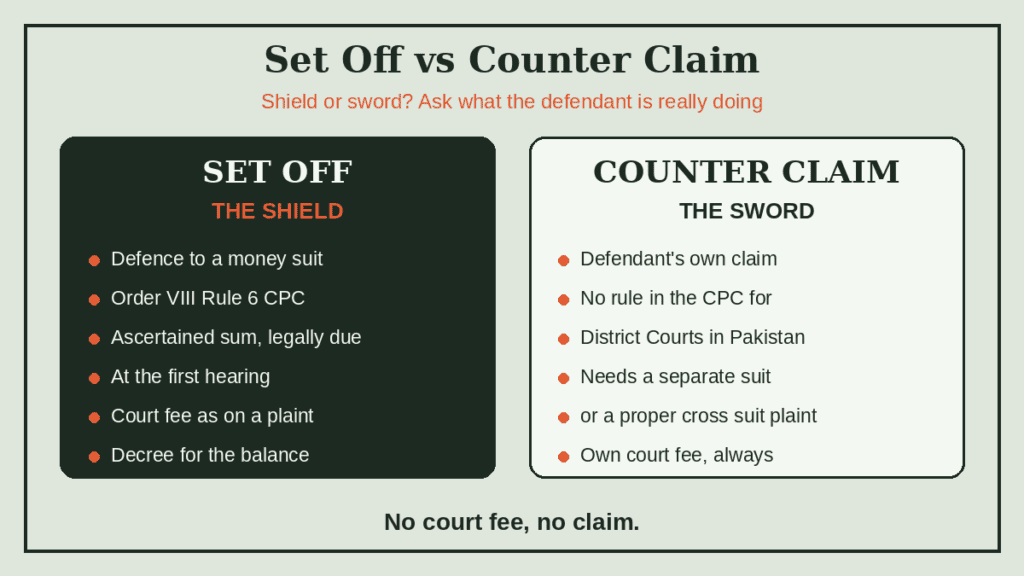
Set-Off vs Counterclaim: Difference Table
| Point | Set Off | Counter Claim |
|---|---|---|
| Nature | Shield, a defence | Sword, the defendant’s own claim |
| Law in Pakistan | Order VIII Rule 6 CPC, Order XX Rule 19 | No rule in the CPC. High Court Original Side has Rules 162 to 167 |
| Type of suit | Suit for recovery of money | Any claim against the plaintiff |
| Amount | Ascertained sum (equitable set-off can be unascertained) | Any claim, including damages or possession |
| Time | First hearing, later only with permission | Not in the CPC. Separate suit, or a cross-suit plaint |
| Court fee | Payable, as on a plaint | Payable, as on a plaint |
| Result | Decree for the balance | Decided like a separate suit |
| Example | Adjusting an earlier loan against the price | Claiming possession or damages from the plaintiff |
Set-Off vs CounterClaim Court Fee: The Rule Many Forget
This is where many claims fall. A defendant cannot ride on the plaintiff’s court fee. Three rules sit behind this.
- Court Fees Act, 1870, Section 4. A document that is chargeable with a fee cannot be filed, exhibited or recorded in court unless the fee is paid.
- Schedule I, Article 1. A written statement pleading a set-off or counterclaim is chargeable in the same way as a plaint. Check the current fee schedule as amended in Sindh.
- Suits Valuation Act, 1887, Section 8. In suits where ad valorem court fee is payable, the value for court fee and the value for jurisdiction are the same. This is why a set-off must also stay within the pecuniary limit of the court.
The Lahore High Court held in Khurshid Ahmed v Khair Din (PLD 1962 (WP) Lahore 313) that a written statement pleading a set-off is a document chargeable to fee, and that it cannot be accepted unless the prescribed fee is paid.
Orders under Order VII Rule 11(c) show how seriously courts treat unpaid fee on a plaint, and our guide to Order VII Rule 11 CPC in Pakistan explains it. The same logic applies to a defendant who wants a decree for his own claim, because Rule 6(2) treats his written statement like a plaint in a cross suit.
Counterclaim After Written Statement: 5 Points to Raise in Court
If the other side tries to add a counterclaim or a new set-off after the written statement and after issues, these are the points to put before the court, in this order.
- The CPC gives a defendant no right to a counterclaim. A written statement is a defence. The only claim a defendant can include in it is a set-off under Order VIII Rule 6, or an equitable set-off. This is the view of the Supreme Court in Niamat Ali (PLD 1983 SC 5).
- A set-off has a time limit. Rule 6(1) allows it at the first hearing and not afterwards unless the court permits. Once the written statement is filed and issues are framed, the stage has passed. A later claim needs the court’s permission, and it must be justified.
- The claim must fit the conditions. It must be a money suit, an ascertained and legally recoverable sum, between the same parties in the same capacity, within the court’s pecuniary limit (Japak, 2009 SCMR 666). A claim for possession, unliquidated damages or a cause of action that accrued after the suit does not fit. The High Court also noted in Ahmad Hassan (1985 CLC 1575) that such claims are not appropriately entertainable, and the defendant is not stopped from approaching a competent court separately.
- The remedy is a separate suit. A new claim needs its own plaint, its own cause of action and its own limitation. If a court is asked to treat the pleading as a plaint in a cross suit, it must meet all the requirements of a plaint, including court fee.
- Court fee is compulsory, and the old fee cannot cover it. The new claim is chargeable under the Court Fees Act (Section 4 and Schedule I, Article 1) in the same manner as a plaint. Without the fee, the claim cannot be accepted (Khurshid Ahmed, PLD 1962 (WP) Lahore 313). In the Sindh High Court’s 2018 decision in Soofi Rice Mills v NBP, the court noted that no court fee had ever been paid on the so-called counterclaim, and that claim failed.
What happens to the claim: The court does not entertain it, so the defendant is left to file a separate suit. It is the claim that is rejected, not the plaintiff’s suit.
Procedure point: issues are framed on the pleadings. If an issue has been raised on a claim that is not properly before the court, Order XIV Rule 5 CPC allows the court to amend or strike out issues, as the plaintiff asked in the Manzoor Ahmed case.
Set-Off vs CounterClaim: 4 Real Court Cases from Pakistan
Case 1: Niamat Ali v Dewan Jairam Dass (PLD 1983 SC 5)
The Supreme Court drew the line. A set-off is a weapon of defence. A counterclaim is a weapon of offence, in nature a cross-suit. The right to counterclaim is not admissible unless it falls within Order VIII Rule 6 or is an equitable set-off. But if it contains the requisites of a plaint, the court may treat it as a plaint in a cross suit.
In simple words: The defendant cannot just add any claim to his written statement. Either it is a proper set-off, or it must stand as a proper cross suit.
Case 2: Civil Aviation Authority v Japak International (Pvt.) Ltd (2009 SCMR 666)
The Supreme Court set out the six essential conditions of a legal set-off. The Sindh High Court has repeated them (see Soofi Rice Mills below).
In simple words: For a set-off, the amount must be fixed, due, between the same parties, and within the court’s limit.
Case 3: Soofi Rice Mills v NBP (Sindh High Court, Larkana, First Civil Appeal D-03 of 2013, decided 26 September 2018)
A bank got a decree for its loan. The borrowers argued on appeal that the value of their pledged stock should be set off against it. A Division Bench rejected this on several grounds. The claim had never been properly pleaded with particulars. It had not been shown to be legally recoverable or within limitation. And no court fee had ever been paid on the purported counterclaim. The appeal was dismissed.
In simple words: A set-off or counterclaim that is vague, late, and unstamped will not work.
Case 4: Manzoor Ahmed Shahzad v Muhammad Shakir Shan (Sindh High Court, Suit 370 of 2005, order dated 15 August 2018)
The plaintiff sued to cancel a sale agreement for immovable property. The buyers filed a written statement with a counterclaim for specific performance and paid the court fee. The plaintiff asked to strike out the issue arising from it, arguing the CPC allows counterclaims only as set-offs in money suits.
The High Court agreed that Niamat Ali treats counterclaims narrowly, but held that on the Original Side the Sindh Chief Court Rules (O.S.), Rule 162, specifically allow a counterclaim. So the counterclaim stayed, and the plaintiff got two weeks to reply.
In simple words: The result depended on which court the suit was in. The High Court Original Side has its own rules on counterclaims. District Courts follow the CPC.
From the Courtroom: When the Other Side Wants a Counterclaim After Issues Are Framed
In a recent civil suit argued before a trial court, the plaintiff filed a suit for recovery of an amount. The defendant filed a written statement, issues were framed, and after that the issues were amended. The other side then asked to bring a counterclaim in the same suit.
Without going into the merits, the points we raised were these. A counterclaim cannot be made in the same suit after the written statement. If a party wants to claim something against the plaintiff, it must file a separate suit and pay the separate court fee.
A new claim, whether it is a set-off or a counter prayer, needs court fee and cannot be adjusted within the court fee of the old suit. Without that fee, the claim is not entertained, and the reported judgments say so.
Set-Off vs Counterclaim Examples in Simple Words
Example 1: A valid legal set-off. Zeeshan, a cloth wholesaler, sues Imran for Rs. 500,000, the unpaid price of goods. Imran says Zeeshan owes him Rs. 200,000 on a signed receipt for a loan, due last year and not time-barred. In his written statement, Imran gives particulars, pays court fee on Rs. 200,000 and claims set-off. If both claims are proved, the decree is for Rs. 300,000.
Example 2: Set-off bigger than the plaintiff’s claim. If Imran’s claim were Rs. 700,000, it wipes out Zeeshan’s claim and the extra Rs. 200,000 is, in effect, a claim for the balance. Because it behaves like a plaint for that balance, it must follow the rules of pleading (Kirmani, 1993 SCMR 441) and carry the fee.
Example 3: Equitable set-off. A contractor sues for Rs. 1,000,000 as the balance for building work. The owner says the work was defective and repairs will cost about Rs. 300,000. The amount is not fixed yet, but it comes from the same contract, so an equitable set-off may be allowed instead of forcing the owner into a separate suit.
Example 4: Not a set-off, a counterclaim. A plaintiff sues for Rs. 400,000. The defendant wants to claim possession of his shop from the plaintiff, or damages for a different incident. This is not an ascertained money sum arising from the same dealings. It needs a separate suit with its own fee.
Test Yourself: Set Off vs CounterClaim Quiz
Cover the answers and decide before you read them.
Scenario 1. In a money suit, the defendant pleads that the plaintiff owes him a fixed, undisputed Rs. 100,000 from a loan and pays court fee on it. What is this?
Answer: A legal set-off under Order VIII Rule 6.
Scenario 2. After issues are framed, the defendant asks to claim possession of a plot from the plaintiff in the same suit, without paying fee. What is the position?
Answer: Not entertainable. It is a counterclaim, not a set-off. It needs a separate suit and its own court fee.
Scenario 3. A student cites Order VIII Rule 6A in a Pakistani District Court. What is wrong?
Answer: Rule 6A belongs to the Indian CPC and is not part of the Pakistani Code.
How an Advocate Handles Set-Off vs CounterClaim Stage by Stage
If you act for the plaintiff and the other side seeks a late counterclaim
- Collect the record. Get the written statement, the order sheet showing when issues were framed and amended, and any court fee receipts.
- Object in writing at once. File written objections or a reply to the application. Do not wait for the stage of evidence.
- Put the five points in order, as set out above, with the citations.
- Ask the court to decide maintainability and court fee first. If an issue has been framed on the claim, move under Order XIV Rule 5 to strike it out.
- Also oppose indirect routes. If an application under Order VI Rule 17 is used to bring a counterclaim in through amendment, argue that it adds a new independent claim.
- Urgent situation: if the application is fixed for early hearing, file your objection before that date, with copies of the relevant pages and the extracts of Order VIII Rule 6.
If you act for the defendant
- Decide on the first day whether you have a set-off. If you do, put it in the written statement, with particulars, at the first hearing.
- Pay the court fee with the written statement. Do not wait to be told.
- Plead the amount and its basis. Vague claims for damages fail (Kirmani, 1993 SCMR 441).
- If your claim is not a set-off, file your own suit in time. Check limitation, and ask the court to hear the two suits together because cross suits are usually heard together. Our Res Judicata vs Res Sub Judice guide explains why you should check for overlap between the two suits.
Malafide and Dishonesty Markers in Set Off vs Counterclaim Cases
These are the usual signs of a tactical, not genuine, claim:
- A setoff or counterclaim that appears only after issues are framed, just to reopen the trial.
- A claim with no particulars, or one that exaggerates a vague damages figure.
- Pleading a time-barred debt as if it were legally recoverable.
- Filing the written statement without the court fee and asking for time again and again.
- Pleading the same amount in a separate suit in another court while also claiming it as a set off.
- A claim that has nothing to do with the plaintiff’s cause of action, added only to put pressure.
Common Mistakes in Set Off vs Counterclaim Answers
- Treating set off and counterclaim as the same thing.
- Quoting Order VIII Rule 6A in a Pakistani answer.
- Forgetting the first hearing time limit in Rule 6(1).
- Saying a set off can be for any amount. It must be ascertained and within the pecuniary limit.
- Forgetting that court fee is compulsory.
- Writing that the suit is dismissed when the counterclaim is not entertained. Only the claim fails.
Exam tip: In a problem question, take four steps. First, ask whether the suit is for money. Second, ask whether the defendant’s claim is an ascertained sum, due, and within the pecuniary limit. Third, apply Rule 6 for set off, or Niamat Ali for counterclaim. Fourth, state the court fee and time consequences.
Frequently Asked Questions
1. Can a defendant make a counterclaim in the same suit in Pakistan?
Not as a matter of right under the CPC. Only a set off under Order VIII Rule 6, or an equitable set off, is allowed. The court may treat a proper pleading as a plaint in a cross-suit, but it must meet plaint requirements and carry court fee.
2. Is there an Order VIII Rule 6A in the Pakistani CPC?
No. The Pakistani cases discussed here say the Code has only Rule 6, and Rules 6A to 6G are part of the Indian CPC. Confirm the current bare act before citing.
3. Is court fee payable on a set off?
Yes. A written statement pleading a set off is chargeable in the same way as a plaint, and it cannot be accepted unless the fee is paid.
4. When must a set off be claimed?
At the first hearing of the suit, and afterwards only with the court’s permission.
5. What is the difference between legal and equitable set off?
A legal set off is for an ascertained sum. An equitable set off can be for an unascertained sum if it is closely connected to the plaintiff’s claim.
6. Does the Sindh Chief Court Rules counterclaim apply in District Courts?
No. They apply on the Original Side of the High Court.
Quick Recap: Set Off vs Counterclaim
- Set off: shield, money suit, ascertained sum, first hearing, court fee, decree for the balance.
- Counterclaim: sword, the defendant’s own claim, no rule in the CPC, needs a separate suit or a proper cross-suit plaint.
- No Rule 6A in Pakistan. It is an Indian provision.
- Court fee: compulsory, and the old suit’s fee cannot cover a new claim.
- Result: the late claim is not entertained, and the defendant files a separate suit.
Disclaimer
This post is for general legal education and is not legal advice for any specific case. Always check the current bare act and the official law report before relying on any provision or case.
Did this make set off vs. counterclaim clear?
If any point is still confusing, or you faced a similar situation in court, tell us in the comments below. Ask your question and we will reply with a simple example. If this guide helped you, share it with a fellow law student or advocate who struggles with the same topic.